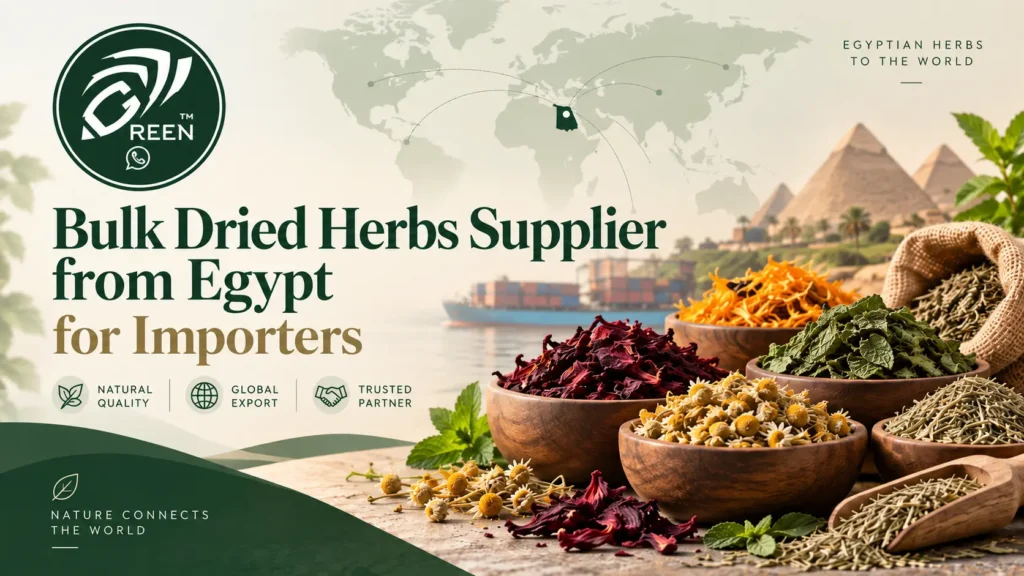
Bulk Dried Herbs Supplier from Egypt for Importers
Finding a reliable Bulk Dried Herbs Supplier from Egypt for Importers requires more than simply identifying a company that can provide agricultural products in large quantities. International importers need a supplier capable of maintaining consistent product specifications, managing drying and processing, providing suitable packaging, supporting export documentation, organizing logistics, and maintaining clear traceability throughout the supply chain.
Egypt has a long agricultural heritage and produces a wide range of herbs, spices, flowers, and natural ingredients used by food manufacturers, wholesalers, distributors, beverage companies, seasoning businesses, brands, and industrial buyers around the world. For importers, however, agricultural origin is only the beginning because the commercial value of dried herbs also depends on how the crop is cultivated, harvested, dried, processed, tested, stored, packaged, and prepared for international shipment.
Green Company has been cultivating, processing, and supplying Egyptian herbs and spices since 1919. Across four generations, the company has developed an integrated operation combining responsible agriculture, advanced processing, strict quality control, full product traceability, packaging, and professional international supply.
Why Importers Source Dried Herbs from Egypt
Egypt offers agricultural conditions suitable for producing a diverse range of herbs, spices, flowers, and botanical ingredients for international markets. Egyptian agricultural products are used in food manufacturing, seasoning production, herbal beverages, tea, sauces, soups, ready meals, retail products, private-label ranges, and industrial ingredient applications.
For importers, sourcing from Egypt can provide access to several product categories through the same agricultural market. The real challenge is choosing a supplier capable of converting those crops into commercially reliable ingredients that meet the buyer’s required specifications and can be supplied consistently over repeated orders.
What Importers Need from a Bulk Dried Herbs Supplier
Importers usually purchase larger quantities than retail buyers and may manage several shipments throughout the year. This means they need a supplier that understands not only the product itself but also commercial quantities, technical specifications, drying, processing, packaging, export preparation, documentation, storage, transportation, and repeat supply.
A professional bulk herbs supplier should understand exactly what the importer intends to do with the product after arrival. Herbs intended for a food manufacturer may require different preparation from products intended for a tea company, wholesaler, repacking business, seasoning company, or retail brand.
Understanding Bulk Dried Herbs Supply
Bulk dried herbs are commercial ingredients supplied in larger quantities for business use. They may be imported for food manufacturing, seasoning production, local repacking, wholesale distribution, herbal beverage production, foodservice supply, retail brands, private-label projects, or further industrial processing.
The exact product format should therefore be determined according to its final use. Importers should establish the required form, processing level, packaging, volume, and destination requirements before confirming an order.
Dried Herbs for Food Ingredient Importers
Food ingredient importers supply herbs to factories producing sauces, soups, ready meals, meat products, bakery products, snack seasonings, marinades, dressings, and other processed foods. These businesses normally require well-defined specifications because the ingredients must perform consistently within established recipes and production processes.
For this type of importer, differences in appearance, aroma, moisture, cut size, or processing can affect the expectations of their manufacturing customers. Consistency between shipments therefore becomes one of the most important factors in supplier selection.
Dried Herbs for Distributors
Herb and spice distributors often need several products rather than purchasing only one ingredient. A distributor may source herbs, flowers, spices, seeds, botanical ingredients, and seasoning components within the same procurement cycle.
Working with a diversified supplier can simplify purchasing and reduce the number of supply relationships that need to be managed. Green Company positions its product portfolio for manufacturers, distributors, brands, and industrial buyers worldwide, with categories extending across herbs, spices, flowers, and other natural ingredients.
Dried Herbs for Wholesalers
Wholesalers generally purchase commercial quantities for resale to smaller businesses, retailers, foodservice companies, manufacturers, or local distributors. Their priorities often include reliable supply, suitable bulk packaging, stable product quality, efficient storage, and straightforward logistics.
Since wholesalers serve multiple customers, inconsistent products can create difficulties across several downstream relationships. Choosing a supplier with organized quality control and processing therefore becomes especially important.
Dried Herbs for Private-Label Businesses
Private-label companies may need more than the raw agricultural ingredient because their projects can involve processing, blending, packaging, different pack sizes, brand-specific requirements, and international shipment preparation.
Green Company’s current service model covers herbs and spices export, packaging solutions, drying and processing, storage, and global delivery, allowing B2B customers to manage several stages of the supply process through one supplier.
Egyptian Dried Herbs and Natural Ingredients for Importers
Egypt produces a wide range of agricultural ingredients that can be supplied to international buyers. Green Company’s current featured product range includes hibiscus, chamomile, calendula, black pepper, black lime, and bay leaves, while the company positions its wider portfolio around herbs, spices, seeds, and natural ingredients for global B2B customers.
The suitability of each product depends on the target application. Some ingredients are primarily used in food manufacturing, while others are popular in herbal beverages, tea, seasoning production, retail packaging, wholesale distribution, or industrial formulations.
Egyptian Hibiscus for Bulk Import
Egyptian hibiscus is used across beverage, herbal, and food markets because of its naturally deep color and characteristic tart profile. It can be supplied to tea businesses, beverage manufacturers, distributors, wholesalers, ingredient companies, and brands developing botanical products.
Green Company currently presents premium Egyptian hibiscus as an ingredient carefully selected and processed for beverages, herbal blends, and food applications.
Egyptian Chamomile for International Buyers
Chamomile is widely used in herbal teas, infusions, botanical blends, and industrial applications. Buyers generally pay close attention to flower appearance, natural aroma, cleanliness, processing, storage, and packaging because these characteristics influence both product quality and presentation.
Green Company describes its Egyptian chamomile as having a gentle floral aroma and clean natural appearance and positions it for tea, herbal, and industrial applications.
Egyptian Calendula Flowers
Calendula is used in herbal blends, tea products, extracts, natural formulations, and selected food applications. Maintaining the natural appearance and color of the flowers during drying, processing, storage, and transportation is an important consideration for commercial buyers.
Green Company includes premium calendula flowers within its product portfolio and describes them as suitable for herbal blends, teas, extracts, and food applications.
Egyptian Bay Leaves
Bay leaves are used in soups, sauces, stews, marinades, seasoning products, and industrial food applications. Bulk buyers may include food manufacturers, spice businesses, wholesalers, restaurants, distributors, and ingredient importers.
Green Company supplies premium bay leaves with a characteristic herbal aroma and flavor and positions the product for both culinary and industrial food applications.
Egyptian Black Pepper
Black pepper is one of the most widely used spices in international food production and can be incorporated into seasoning blends, meat products, sauces, marinades, snacks, ready meals, and other processed foods.
Green Company’s current product portfolio includes premium black pepper with a bold aroma and warm flavor, designed for seasoning, meat, sauce, marinade, and food-processing applications.
Egyptian Black Lime
Black lime is widely used in Middle Eastern cuisine and can also be incorporated into commercial seasoning blends, sauces, marinades, and food formulations. Its characteristic citrus profile gives it a distinct position within spice and seasoning applications.
Green Company currently lists dried black lime among its core products and describes it as having a deep citrus aroma with a tangy and slightly smoky flavor.
Agricultural Origin Is the Beginning of Herb Quality
Bulk dried herb quality begins before the product reaches a processing facility. Plant variety, cultivation conditions, agricultural practices, harvest timing, and post-harvest handling all contribute to the final product characteristics received by the importer.
Green Company’s supply model starts at the agricultural stage and follows the product through seed selection, cultivation, harvesting, processing, quality testing, packaging, and global shipping. This approach allows product handling to be monitored across the complete journey from origin to destination.
Seed Selection
Seed selection can influence plant characteristics, productivity, aroma, appearance, and suitability for a specific application. Choosing the appropriate variety is therefore an important starting point for agricultural products intended for commercial processing and international markets.
For buyers planning recurring imports, greater control over agricultural origin can help support more consistent products over time.
Cultivation
The cultivation stage determines how the crop develops before harvest. Responsible agricultural management includes monitoring crop development and maintaining suitable growing conditions according to the requirements of the plant.
Green Company describes its cultivation stage as responsible growing in fertile Egyptian soil and includes cultivation as a core part of its full traceability system.
Harvesting
Harvest timing affects important product characteristics such as appearance, aroma, texture, and overall plant condition. Crops should be handled carefully before entering drying and processing because poor handling at this stage can reduce the quality achieved during cultivation.
Green Company’s supply process places harvesting between cultivation and controlled processing, reflecting its role as an essential link between the agricultural and manufacturing stages.
Drying Dried Herbs for Export
Drying is one of the most critical stages in producing herbs for international trade. Fresh agricultural materials naturally contain moisture, and controlled drying prepares them for processing, storage, packaging, transportation, and longer supply chains.
A professional drying process should do more than simply reduce moisture. It should also help preserve the natural characteristics that give the herb commercial value, including color, aroma, essential oils, and overall product integrity.
Why Controlled Drying Matters
Poor drying can affect herbs through loss of aroma, changes in color, uneven moisture, inconsistent appearance, reduced storage stability, and difficulties during later processing. These problems can become especially costly when products are being purchased in commercial quantities and transported internationally.
Green Company states that its herb drying and handling methods are designed to preserve natural color, aroma, essential oils, and overall quality, with each stage managed to produce clean and reliable ingredients.
Processing Dried Herbs According to Buyer Requirements
After drying, herbs may require further preparation before they are ready for commercial use. The exact processing depends on the product, intended application, buyer specification, and whether the ingredient will be used directly or processed again after import.
Some customers may need whole products, while others may require specific cuts, preparation for blending, or material intended for further processing. This is why importers should communicate their technical requirements before finalizing the order.
Whole Dried Herbs
Whole dried herbs can be suitable for wholesalers, repacking businesses, specialty distributors, tea companies, and processors that want to conduct additional preparation after import. Their suitability depends on the specific herb and intended market.
An importer should define whether the product needs to remain whole throughout shipping or whether additional preparation will be required before packaging and distribution.
Cut Dried Herbs
Cut products are commonly required by food manufacturers and seasoning companies because size and uniformity can influence blending, appearance, production performance, and the final product.
The requested cut should therefore be agreed before production or shipment. Requesting only the name of the herb without identifying the required form may not provide enough information for an accurate commercial offer.
Why Product Specifications Matter
Clear specifications are one of the most important parts of international herb purchasing. The supplier needs to understand what the importer expects before preparing the order because different customers can require very different versions of the same agricultural ingredient.
A complete specification should normally define the product, required format, processing needs, expected quantity, packaging, destination country, final application, delivery requirements, and any specific quality or documentation expectations.
Quality Control for Bulk Dried Herbs
Quality control should not be limited to inspecting the finished shipment immediately before export. A stronger system monitors the product throughout its journey and identifies important checkpoints before packaging and delivery.
Green Company states that every batch is carefully monitored throughout its supply chain to support transparency, consistent quality, and product integrity from origin to delivery. Quality testing is also identified as a specific stage before packaging and international shipping.
Batch Consistency for Importers
Importers often purchase the same products repeatedly, which makes consistency across batches particularly important. Large differences in appearance, aroma, product form, moisture, or other agreed characteristics can create difficulties for the importer’s customers.
Food manufacturers may need predictable ingredients for established recipes, while distributors and wholesalers need products that meet customer expectations from shipment to shipment. Organized sourcing and processing therefore become important parts of long-term supplier performance.
Product Appearance
Appearance can be important when evaluating dried herbs, flowers, spices, and botanical ingredients. Buyers may assess color, condition, uniformity, size, or general presentation depending on the product and intended use.
However, visual appearance should never be considered separately from the agreed technical and commercial specification because different applications can require different product characteristics.
Aroma and Flavor
Aroma and flavor are central qualities in many herbs and spices and can be influenced by cultivation, harvest timing, drying, processing, storage, packaging, and transportation.
For food manufacturers and seasoning businesses, differences in aromatic characteristics can affect the final formulation, which is why careful handling throughout the supply chain is important.
Moisture Management
Dried products require appropriate moisture control to support stability during storage and transportation. The suitable level can differ according to the product, processing method, customer requirement, and destination.
Importers should therefore communicate technical requirements in advance instead of assuming the same specification applies to every dried herb or botanical ingredient.
Product Cleanliness and Integrity
Product cleanliness is influenced by every stage of the supply chain, from agricultural handling through processing, storage, packaging, and shipping. Commercial buyers need ingredients prepared according to the agreed requirements and handled in a way that supports product integrity.
An integrated supplier can coordinate these stages more effectively because the product remains within a connected operating system from source to shipment.
Full Traceability for International Importers
Traceability allows importers to understand how products move through their supply chain. It can provide greater visibility into agricultural origin, processing, quality checks, packaging, batch handling, and final preparation for export.
Green Company’s traceability system covers seven defined stages: seed selection, cultivation, harvesting, processing, quality testing, packaging, and global shipping.
Why Traceability Matters in B2B Herb Supply
For businesses handling recurring shipments, traceability supports transparency and better supply-chain management. It allows purchasing teams to connect the finished shipment with the different stages that produced and prepared it.
This becomes especially relevant for food manufacturers, international distributors, brands, and industrial buyers that need organized and repeatable sourcing processes.
Packaging Dried Herbs for International Import
Packaging is an important part of protecting herbs during storage, loading, international transportation, customs procedures, warehousing, and final distribution. The suitable packaging solution depends on the product, quantity, buyer, shipping method, destination, and final use.
Green Company offers flexible packaging solutions in different weights and formats and states that these solutions are designed for retail, wholesale, and export markets while helping protect freshness and maintain product quality.
Bulk Packaging for Importers
Bulk packaging is commonly used by importers supplying manufacturers, wholesalers, distributors, seasoning businesses, and companies that repack products locally. The ideal packaging format should make commercial handling efficient while protecting the ingredient throughout the international supply chain.
Before confirming an order, the buyer and supplier should agree on packaging requirements alongside product specifications so that the shipment can be prepared correctly from the beginning.
Packaging for Manufacturers
Food manufacturers may prefer packaging formats that fit their production volumes, warehouse systems, ingredient consumption, and handling procedures. The most suitable option can therefore vary from one manufacturer to another.
Importers supplying factories should understand their customers’ packaging needs before placing the order with the exporter.
Packaging for Private-Label Buyers
Private-label businesses can require specialized packaging depending on product positioning, target customer, pack size, distribution model, and retail strategy. In these cases, packaging becomes part of the commercial product rather than simply a transportation method.
Working with a supplier that provides packaging support alongside sourcing and processing can simplify the coordination required for these projects.
Storage Before Export
Dried herbs may need to remain in storage while the order is being completed, packaged, documented, consolidated, or scheduled for shipment. Proper handling during this period is important because even well-processed ingredients can be affected by unsuitable storage conditions.
Green Company’s service model covers sourcing, processing, packaging, storage, and global delivery as part of an integrated herbs and spices supply solution.
Export Documentation for Importers
International herb shipments require appropriate documentation, and exact requirements can vary according to the product, destination market, buyer, shipping method, and applicable regulations.
Export documentation should therefore be discussed during the planning stage instead of being left until the shipment is ready. Green Company states that its herbs and spices export service covers preparation and documentation alongside packaging and logistics for international markets.
Why the Destination Country Matters
The final destination can influence documentation, import procedures, logistics, shipping arrangements, packaging requirements, and certain commercial specifications. An exporter cannot prepare the most relevant shipment plan without knowing where the products are going.
Importers should therefore provide the destination country during the initial inquiry together with product details and expected quantity.
Shipping Bulk Dried Herbs from Egypt
After the herbs have been processed, checked, packed, and documented, the shipment can move into international transportation. The logistics plan depends on product type, quantity, packaging volume, destination, commercial terms, and required delivery schedule.
For larger commercial orders, logistics planning should be considered early in the purchasing process because transportation requirements can influence packaging, timing, and final cost.
Consolidating Several Products in One Supply Relationship
Many importers need more than one product. A single buyer may source herbs, botanical flowers, spices, and other agricultural ingredients for different customers within the same market.
Working with a supplier that offers a broader portfolio can simplify communication and procurement. Green Company describes its range as a diversified portfolio of herbs, spices, seeds, and natural ingredients designed for food manufacturers, distributors, brands, and industrial buyers worldwide.
Supplying Food Manufacturers Through Importers
Importers often act as the connection between an international exporter and local food factories. These manufacturers may require predictable supply schedules, stable specifications, suitable packaging, and repeat availability throughout the year.
The importer therefore needs a supplier capable of understanding long-term demand rather than focusing only on one shipment.
Supplying Distributors and Wholesalers
Distributors and wholesalers usually need products that can be stored efficiently and supplied to multiple customers. Packaging, product consistency, quantity planning, and availability therefore become key considerations.
Importers serving this sector benefit from discussing future demand and product variety with the supplier before establishing a long-term purchasing relationship.
How to Choose a Bulk Dried Herbs Supplier from Egypt for Importers
Choosing a bulk supplier should involve reviewing the supplier’s complete operation rather than comparing prices alone. Experience, agricultural sourcing, processing capability, quality control, traceability, packaging, export services, logistics, communication, and repeat-supply capability all contribute to the commercial value of the relationship.
A supplier that can coordinate several stages internally or within one integrated operation may provide better visibility throughout the sourcing process.
Check the Supplier’s Experience
A long operating history does not replace proper quality evaluation, but it can demonstrate sustained involvement in the agricultural sector and familiarity with changing commercial requirements.
Green Company’s history in herbs and spices dates back to 1919 and extends across four generations. The company describes its current model as an integrated operation connecting responsible farming, processing technology, strict quality control, traceability, and international markets.
Evaluate Drying and Processing Capabilities
Importers should understand how the products are dried, handled, processed, and prepared because these stages can influence aroma, appearance, product condition, and suitability for the final application.
Green Company’s drying and processing service is specifically designed around preserving natural color, aroma, essential oils, and overall quality.
Review Quality Control
Buyers should understand when products are checked and whether quality control is integrated throughout production. A final inspection alone may not provide enough visibility into what happened earlier in the supply process.
Green Company identifies quality testing as one of its core traceability stages and states that every batch is monitored through the supply chain.
Ask About Traceability
Traceability provides importers with better visibility into product origin and handling. It is particularly useful when managing multiple shipments or supplying manufacturers that require greater transparency across their ingredient supply chain.
A clear traceability system also helps organize communication between supplier and buyer when discussing individual batches.
Review Packaging Options
Packaging should match the characteristics of the product, the commercial quantity, transportation method, storage requirements, and the importer’s own distribution model.
Buyers should therefore discuss packaging at the same time as the product specification rather than treating it as a final detail.
Evaluate Export Capability
A supplier working with importers should understand more than agricultural production. It should also be able to support preparation, packaging, documentation, logistics, and international shipment planning.
Green Company’s current services include complete herbs and spices export solutions covering preparation, documentation, packaging, logistics, and delivery support.
Consider Long-Term Supply Capability
For an importer, a successful first shipment is useful, but the real commercial relationship may involve repeated orders throughout the year. Future demand may include larger quantities, additional products, different packaging formats, or changing market requirements.
Importers should therefore evaluate whether the supplier can develop alongside their business rather than focusing only on the immediate order.
How to Request a Bulk Dried Herbs Quotation
A professional quotation request should clearly identify the product, required format, quantity, packaging, destination country, intended application, delivery expectations, processing requirements, documentation needs, and expected order frequency.
Providing complete information allows the exporter to understand the actual requirement and prepare a quotation that reflects the product and service needed rather than giving only a general price.
What Affects Bulk Dried Herbs Prices?
There is no universal price for all dried herbs because each crop has different agricultural, processing, packaging, and commercial requirements. Pricing can be influenced by the product type, crop availability, season, order quantity, product specification, processing requirements, packaging, destination, logistics, and additional services.
For this reason, importers should compare quotations based on the complete scope of supply rather than comparing only a price per kilogram.
How Product Type Affects Price
Different herbs and botanical ingredients have different cultivation cycles, yields, harvesting requirements, drying methods, and processing needs. Hibiscus, chamomile, bay leaves, calendula, and other products therefore cannot be expected to follow exactly the same pricing structure.
The product should always be identified clearly when requesting commercial information.
How Quantity Affects Price
Order volume affects preparation, packaging, storage, shipment planning, and logistics. Large commercial quantities may require different operational arrangements from smaller wholesale orders.
Providing the expected volume during the initial inquiry helps the supplier evaluate the order more accurately.
How Processing Affects Price
Additional preparation can influence the final quotation because different buyers require different levels of processing. Specific formats, additional handling, preparation for blending, or other special requirements may add stages to production.
These requirements should therefore be disclosed before the quotation is prepared.
How Packaging Affects Price
Packaging materials, format, pack size, and handling requirements can influence both preparation and transportation costs. Large industrial packs are different from smaller wholesale or retail-oriented formats.
Importers should define packaging requirements early so the supplier can include them correctly in the commercial offer.
How Shipping Destination Affects Cost
The destination influences transportation planning, documentation, and logistics costs. Different markets may also involve different import procedures and shipping options.
For an accurate quotation, the importer should always provide the final country and any relevant delivery requirements.
Common Mistakes Importers Make When Buying Dried Herbs
One of the most common mistakes is choosing a supplier based only on the lowest price without evaluating processing, quality control, traceability, packaging, documentation, and long-term reliability. A low initial price may not provide good commercial value if the product does not meet the required specification or creates problems for the importer’s customers.
Another common mistake is providing incomplete information. A request that simply asks for “bulk dried herbs” without defining the product, quantity, format, packaging, destination, and application does not give the supplier enough information to prepare an accurate offer.
Not Defining the Product Format
The same agricultural ingredient can be prepared in several formats, and the correct choice depends on how it will be used after import. A product intended for a food manufacturer may have different requirements from one intended for a tea business or wholesaler.
The importer should therefore specify the required commercial form before confirming the order.
Not Explaining the Final Application
The intended application can influence the most suitable product specification, processing, and packaging. Suppliers need to know whether the herbs will be used for food manufacturing, beverages, tea, wholesale distribution, repacking, seasoning, or another commercial purpose.
Sharing this information makes it easier to discuss the correct product from the beginning.
Leaving Packaging Until the Final Stage
Packaging should not be treated as a last-minute decision because it affects protection, storage, transportation, handling, and potentially total cost.
Discussing packaging early allows both buyer and supplier to plan the order more efficiently.
Ignoring Destination Requirements
Import procedures and documentation requirements can vary by market, so waiting until the shipment is ready before discussing them can create unnecessary complications.
Importers should confirm destination requirements early and communicate any specific documentation or product conditions to the supplier.
Sustainability in Egyptian Herb Supply
Sustainability is becoming increasingly important across international agricultural supply chains. Responsible sourcing can involve protecting natural resources, reducing energy and water consumption, supporting local communities, improving supply-chain transparency, and developing practices that can be maintained over the long term.
Green Company states that its agricultural and manufacturing practices focus on protecting natural resources, supporting local communities, and building a responsible long-term supply chain. The company currently reports 21 newly planted species, a 10% reduction in electricity consumption, and a 15% reduction in water usage.
Why Long-Term Supplier Relationships Matter for Importers
Importers often benefit from developing a stable relationship with their supplier because repeated cooperation creates a clearer understanding of specifications, packaging, quantities, quality expectations, documentation, shipment planning, and seasonal demand.
Over time, this can simplify repeat orders and allow both companies to plan future purchasing requirements more efficiently.
Why Choose Green Company as a Bulk Dried Herbs Supplier from Egypt for Importers?
Green Company combines more than a century of agricultural heritage with processing, quality control, full traceability, packaging, storage, and international export solutions. Its business model is specifically positioned around Egyptian origin, farm-to-shipment management, international supply, and B2B buyers.
For importers looking for a long-term supplier, this integrated structure means the relationship can cover more than simply purchasing a dried agricultural product.
More Than 100 Years of Experience
Green Company’s history dates back to 1919 and spans four generations. During that period, the company has built its operations around Egyptian herbs and spices while continuing to develop processing, quality-control, traceability, and international supply capabilities.
Integrated Farm-to-Shipment Supply
Green Company’s operating approach connects agricultural origin with processing and international delivery. The company’s seven-stage product journey moves from seed selection and cultivation through harvesting, processing, quality testing, packaging, and global shipping.
This gives importers a clearer view of how the product moves through the supply chain before reaching its destination.
Full Product Traceability
Traceability is one of the central elements of Green Company’s current positioning. The company states that every batch is monitored throughout the supply chain to support transparency, consistent quality, and product integrity from origin to delivery.
For importers managing recurring purchases, this approach can make product and batch management more organized.
Controlled Drying and Processing
Green Company provides drying and processing solutions designed to preserve the natural color, aroma, essential oils, and overall quality of herbs. The company states that each processing stage is managed to deliver clean and reliable ingredients.
This is especially relevant for importers supplying manufacturers or brands where ingredient characteristics can directly influence the finished product.
Flexible Packaging Solutions
Green Company offers flexible packaging solutions in different weights and formats for wholesale, retail, and export markets. Packaging is designed to protect the product while supporting different commercial requirements.
This allows importers to discuss packaging based on their own distribution model instead of using a single format for every type of customer.
Professional Export Solutions
Green Company’s herbs and spices export service covers product preparation, documentation, packaging, logistics, and support for global delivery.
For international importers, having several export stages managed within the same supply relationship can make coordination more efficient.
Built for B2B Buyers
Green Company positions its portfolio specifically for food manufacturers, distributors, brands, and industrial buyers worldwide.
This B2B focus means commercial quantities, product specifications, repeat supply, processing, packaging, and international requirements form an important part of the company’s operating model.
Responsible Long-Term Supply
Green Company’s sustainability approach focuses on protecting natural resources, supporting local communities, responsible resource management, and a transparent supply chain. The company also emphasizes quality, transparency, reliability, and long-term partnerships in its international operations.
For importers, this approach supports a supply relationship designed around continuity rather than individual transactions.
From Egypt’s Fields to Global Markets
Green Company’s model is built around connecting Egyptian agricultural production with manufacturers, distributors, brands, and industrial buyers around the world. Its operation combines cultivation, processing, testing, traceability, packaging, storage, export preparation, and international delivery within a connected supply chain.
For businesses searching for a Bulk Dried Herbs Supplier from Egypt for Importers, evaluating this complete process is essential when building a reliable sourcing strategy.
Tips Before Importing Bulk Dried Herbs from Egypt
Before placing a bulk order, importers should clearly identify the product, required quantity, product format, processing requirements, packaging, destination country, intended application, delivery schedule, documentation requirements, and expected frequency of future orders. They should also evaluate the supplier’s agricultural sourcing, processing capability, quality-control system, traceability, packaging options, export experience, and ability to support repeat supply.
A well-prepared inquiry creates a stronger starting point for both the buyer and supplier and reduces unnecessary changes later in the process.
Frequently Asked Questions About Bulk Dried Herbs from Egypt
Can Importers Buy Dried Herbs Directly from Egypt?
Yes. International importers can source Egyptian herbs, spices, and natural ingredients from suppliers that provide commercial quantities and support processing, packaging, documentation, logistics, and international shipment preparation.
What Products Does Green Company Supply?
Green Company’s currently featured products include Egyptian hibiscus, chamomile, calendula, black pepper, black lime, and bay leaves, while the company also describes a wider portfolio of herbs, spices, seeds, and natural ingredients developed for manufacturers, distributors, brands, and industrial buyers.
Does Green Company Work with B2B Importers?
Yes. Green Company explicitly positions its business as built for B2B and serves manufacturers, distributors, brands, and industrial buyers in international markets.
Does Green Company Provide Herb Drying and Processing?
Yes. Green Company provides drying and processing services designed to preserve natural color, aroma, essential oils, and overall product quality while preparing reliable ingredients for commercial use.
Does Green Company Provide Export Packaging?
Yes. The company offers packaging in different weights and formats for wholesale, retail, and export markets, allowing buyers to select formats that match their commercial requirements.
Does Green Company Provide Product Traceability?
Yes. Green Company’s traceability process covers seed selection, cultivation, harvesting, processing, quality testing, packaging, and global shipping.
Does Green Company Support International Export?
Yes. The company’s export service covers preparation, documentation, packaging, logistics, and support for international delivery of Egyptian herbs, spices, and agricultural products.
What Information Should an Importer Send When Requesting a Quote?
An importer should provide the product required, quantity, preferred product format, processing requirements, packaging, destination country, final application, delivery schedule, documentation requirements, and expected order frequency. Providing complete information allows the supplier to evaluate the inquiry more accurately and prepare a more relevant commercial proposal.
Conclusion
Choosing a Bulk Dried Herbs Supplier from Egypt for Importers requires evaluating far more than the initial product price. Importers need to consider agricultural origin, drying, processing, quality control, product consistency, traceability, packaging, storage, documentation, logistics, and the supplier’s ability to support long-term commercial demand.
With a heritage dating back to 1919 and extending across four generations, Green Company supplies Egyptian herbs, spices, and natural ingredients through an integrated system that connects responsible agricultural production with processing, quality control, packaging, traceability, and international export.
From Egypt’s fields to global markets, Green Company supports international manufacturers, distributors, brands, industrial buyers, and importers looking for reliable Egyptian ingredients, professional export solutions, and long-term B2B supply relationships.