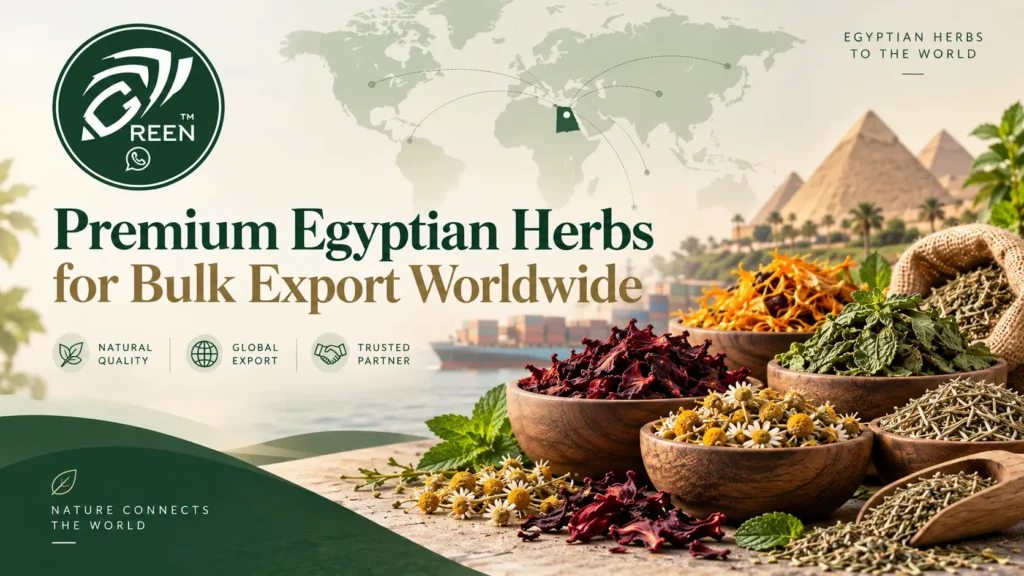
Premium Egyptian Herbs for Bulk Export Worldwide
Sourcing premium Egyptian herbs for bulk export worldwide requires more than finding agricultural products at a competitive price. Importers, food manufacturers, distributors, wholesalers, seasoning companies, and private-label brands need reliable herbs with consistent specifications, professional processing, suitable packaging, traceability, and organized international export support.
Egypt has a long agricultural heritage and produces a diverse range of herbs, flowers, seeds, spices, and natural ingredients used by businesses across the global food and beverage industries.
Products such as basil, marjoram, parsley, dill, cilantro, lemongrass, hibiscus, chamomile, calendula, and other Egyptian agricultural ingredients can serve manufacturers, distributors, wholesalers, and industrial buyers across different markets.
However, successful bulk sourcing does not depend only on where the crop is grown.
Cultivation, harvesting, drying, processing, quality control, storage, packaging, documentation, and shipping all contribute to the quality and commercial suitability of the final product.
Green Company has been cultivating, processing, and supplying Egyptian herbs and spices since 1919. Across four generations, the company has developed an integrated operation combining responsible agriculture, processing, quality control, full product traceability, packaging, and international supply.
Why Egyptian Herbs Are Important for Global Buyers
Egyptian agriculture provides access to a broad range of herbs and botanical ingredients suitable for different international applications.
Global buyers may purchase Egyptian herbs for:
Food manufacturing.
Seasoning production.
Herbal tea.
Beverage production.
Sauces.
Soups.
Ready meals.
Meat products.
Bakery products.
Private-label products.
Retail packaging.
Wholesale distribution.
And industrial processing.
The required product specifications vary according to the final application.
This is why professional bulk sourcing begins with understanding exactly what the buyer needs.
What Does Premium Mean in Bulk Herb Supply?
In B2B herb trading, the word premium should represent more than appearance.
Professional buyers usually evaluate several characteristics before approving a product.
These may include:
Natural aroma.
Color.
Cleanliness.
Product form.
Cut size.
Moisture control.
Processing consistency.
Batch consistency.
Packaging.
Traceability.
Suitability for the intended application.
A product may look good but still be unsuitable for a particular manufacturing process.
For this reason, the buyer and supplier should establish clear specifications before confirming a bulk order.
Who Buys Egyptian Herbs in Bulk?
Bulk Egyptian herbs can serve several types of international customers.
Different buyers have different requirements, but they all need a reliable and organized supply chain.
Food Manufacturers
Food manufacturers use herbs as ingredients in finished products.
They may require herbs for:
Seasoning systems.
Sauces.
Processed meat.
Ready meals.
Soups.
Snack products.
Marinades.
Dressings.
Bakery applications.
And other manufactured foods.
Manufacturers usually need clearly defined specifications because ingredients must fit into established recipes and production systems.
Importers
Importers purchase products from Egypt and distribute them within their markets.
They may supply manufacturers, wholesalers, retailers, restaurants, foodservice businesses, or repacking companies.
Importers therefore need reliable product information, packaging, export documentation, and organized shipment preparation.
Distributors
Distributors may require several herbs and spices from one supplier.
Working with a diversified supplier can help reduce the complexity of managing multiple sourcing relationships.
It may also make it easier to discuss recurring demand, consolidation, and product planning.
Wholesalers
Wholesalers normally purchase commercial quantities for resale.
They may require standard bulk packaging or specific packaging formats according to their customers.
Consistent product quality is important because wholesalers often supply multiple downstream businesses.
Seasoning Manufacturers
Seasoning companies use herbs, spices, seeds, and other ingredients to develop blends.
They may need specific cut sizes, aroma profiles, appearance, and processing characteristics.
Some also require customized herb and spice blends prepared according to their formulations.
Private-Label Brands
Private-label brands can require more than the raw agricultural ingredient.
Their needs may include:
Product preparation.
Blending.
Packaging.
Different pack sizes.
Consistent specifications.
And export support.
Green Company provides packaging, herb processing, export solutions, customized blends, and herb and spice supply for different B2B customer types.
Main Egyptian Herbs for Bulk Export
Egypt produces many herbs suitable for commercial export.
Green Company’s current portfolio includes a broad range of herbs, flowers, seeds, spices, blends, and other natural ingredients designed for food manufacturers, distributors, brands, and industrial buyers worldwide.
Egyptian Basil
Basil is widely used across the international food industry.
Typical applications include:
Pasta products.
Tomato sauces.
Pizza seasonings.
Seasoning blends.
Marinades.
Prepared foods.
And processed food applications.
Bulk buyers may evaluate basil according to color, aroma, cleanliness, cut, processing, and overall consistency.
Green Company offers Egyptian basil cultivated and processed for consistent quality and a distinctive aromatic profile.
Egyptian Marjoram
Marjoram is an important Mediterranean herb used across seasoning and food production.
It can be used in:
Meat seasonings.
Sauces.
Dry blends.
Ready meals.
Savory products.
Mediterranean recipes.
And industrial food manufacturing.
Green Company’s Egyptian marjoram is processed to maintain purity, color, aroma, and natural characteristics.
Egyptian Parsley
Dried parsley is widely used by food manufacturers and seasoning businesses.
Applications may include:
Soups.
Sauces.
Dry mixes.
Vegetable blends.
Ready meals.
Dressings.
Seasonings.
Green Company’s current product range includes both flat parsley and curly parsley for food manufacturing, seasoning, and dried-herb applications.
Egyptian Dill
Dill is commonly used in:
Pickling.
Sauces.
Dressings.
Seasonings.
Processed foods.
And culinary applications.
International buyers may require different product formats depending on how the ingredient will be used.
Green Company supplies dill tips selected for seasoning, pickling, and food production.
Egyptian Cilantro
Cilantro is used in many food and seasoning applications.
It can be incorporated into:
Sauces.
Marinades.
Seasoning blends.
Ready meals.
Regional foods.
Processed products.
Green Company’s Egyptian cilantro is prepared for food manufacturing, seasoning blends, and culinary applications.
Egyptian Lemongrass
Lemongrass is valued for its fresh citrus profile.
It can be used in:
Herbal teas.
Infusions.
Beverages.
Seasoning blends.
Sauces.
Food manufacturing.
Natural ingredient applications.
Green Company offers Egyptian lemongrass suitable for food, tea, and industrial uses.
Egyptian Molokhia
Molokhia is a recognizable Egyptian crop with demand in regional and international food markets.
It can be supplied for:
Food manufacturing.
Distribution.
Retail.
Repacking.
Traditional food products.
Green Company supplies Egyptian molokhia processed to help preserve its natural color, texture, and quality.
Egyptian Hibiscus
Hibiscus is one of the best-known Egyptian botanical ingredients.
Its deep natural color and characteristic tart profile make it suitable for:
Herbal beverages.
Tea blends.
Cold drinks.
Infusions.
Botanical mixes.
Food products.
Green Company supplies Egyptian hibiscus selected and processed for beverage, herbal-blend, and food applications.
Egyptian Chamomile
Chamomile is widely used in tea and botanical applications.
Bulk buyers may focus on:
Flower appearance.
Natural aroma.
Cleanliness.
Processing.
Storage.
Packaging.
Green Company supplies Egyptian chamomile processed for tea, herbal, and industrial applications.
Egyptian Calendula
Calendula is another botanical flower available for international buyers.
It can be used in:
Herbal blends.
Tea.
Extracts.
Food applications.
Natural products.
Maintaining the flower’s natural appearance and color is particularly important during processing.
Green Company includes premium calendula among its current flower portfolio.
Bay Leaves
Bay leaves are widely used in food preparation and industrial food production.
They can be used in:
Soups.
Sauces.
Stews.
Marinades.
Seasoning products.
Food manufacturing.
Green Company’s portfolio includes bay leaves selected for their herbal aroma and characteristic flavor.
Herbs, Spices, Seeds, and More
A global buyer may require more than traditional dried herbs.
Green Company’s portfolio extends across several product categories, including:
Flowers.
Herbs.
Mechanically dehydrated products.
Mixes.
Oleoresins.
Seeds.
Spices.
This broader range can be particularly useful for manufacturers and distributors looking to source several ingredients through one commercial relationship.
Bulk Herb Export Starts at the Agricultural Stage
Export quality is created long before the product reaches the packaging line.
A reliable supply chain begins at the agricultural stage.
Green Company’s traceability model follows seven major stages:
Seed selection.
Cultivation.
Harvesting.
Processing.
Quality testing.
Packaging.
Global shipping.
Seed Selection
Selecting the appropriate plant variety can influence several characteristics of the final crop.
These may include:
Yield.
Appearance.
Flavor.
Aroma.
Plant development.
Suitability for processing.
Controlling the supply chain from an early stage can help improve product consistency later.
Cultivation
The agricultural stage influences the final characteristics of herbs.
Professional production requires appropriate management throughout the growing cycle.
For international buyers, understanding how closely a supplier works with agricultural production can provide better visibility into the origin of the products being purchased.
Harvesting
Harvest timing can influence the commercial quality of herbs.
Different crops reach their desirable characteristics at different stages.
Proper handling during harvesting is also important because the crop must then move into drying and processing.
Why Drying Is Critical for Premium Herbs
Drying is one of the most important stages of herb production.
Freshly harvested plants contain natural moisture.
Removing that moisture in a controlled way prepares the product for storage, processing, packaging, and export.
But drying should not only reduce moisture.
It should also protect the characteristics that make the product valuable.
Green Company states that its herb drying and handling methods are designed to preserve natural color, aroma, essential oils, and overall quality.
Problems Caused by Poor Drying
Improper drying can affect a product in several ways.
Potential problems include:
Loss of natural color.
Reduced aroma.
Uneven moisture.
Inconsistent appearance.
Reduced storage stability.
Difficulty during further processing.
This is why bulk buyers should consider processing capability when selecting an exporter.
Processing After Drying
After drying, products may require additional preparation.
The exact process depends on the herb and the customer’s requirements.
Some buyers need whole material.
Others need cut herbs.
Some require products prepared for immediate industrial use.
Others may conduct additional processing after import.
Clear communication before production reduces the risk of specification differences.
Whole Herbs for Bulk Supply
Whole herbs may be suitable for:
Wholesalers.
Repackers.
Tea manufacturers.
Further processors.
Specialty distributors.
The required product form should always reflect the intended use.
Cut Herbs for Industrial Applications
Food manufacturers often use cut herbs.
Different applications may require different cut sizes.
A seasoning blend, for example, may need a different product format from a retail herb pack.
The required cut should therefore be specified when requesting a quotation.
Importance of Product Specifications
A professional bulk order should clearly identify the product requirements.
These may include:
Product name.
Botanical or commercial type where necessary.
Product form.
Cut size.
Quantity.
Packaging.
Destination.
Final application.
Special processing requirements.
Documentation requirements.
The clearer the specification, the easier it is for the supplier to assess the order accurately.
Quality Control in Bulk Herb Export
Bulk supply requires reliable quality control.
Inspection at the end of production alone is not enough.
The product should be managed through several stages.
Green Company states that each batch is monitored throughout its supply chain, with quality testing forming a dedicated stage before packaging and global shipping.
Batch Consistency
Agricultural products naturally vary.
However, professional sourcing and processing can help reduce unnecessary differences.
For B2B customers, consistency is especially important.
Manufacturers need ingredients that perform predictably in production.
Distributors need products that match customer expectations.
Brands need products that maintain a recognizable standard over time.
Product Color
Color is an important buying factor for many leafy herbs and botanical flowers.
Examples include:
Basil.
Parsley.
Dill.
Cilantro.
Marjoram.
Hibiscus.
Calendula.
However, visual appearance should be considered alongside aroma, cleanliness, moisture, processing, and application requirements.
Aroma
Aroma is another important commercial characteristic.
Harvesting, drying, processing, storage, and packaging can all influence it.
For seasoning manufacturers and food companies, aroma consistency can affect the final formulation.
Moisture Management
Moisture control is essential in dried products.
Appropriate drying and storage help maintain product stability during storage and transportation.
Required specifications can differ according to the product and customer.
For this reason, technical requirements should be agreed before confirming a bulk shipment.
Product Cleanliness
Commercial herb buyers expect products prepared to meet agreed requirements.
Every stage contributes to final product quality, including:
Cultivation.
Harvesting.
Drying.
Processing.
Handling.
Storage.
Packaging.
A well-managed process helps create ingredients suitable for professional B2B supply.
Full Traceability for International Buyers
Traceability allows products and batches to be followed through their supply chain.
This provides international buyers with better visibility into how products are handled from origin through delivery.
Green Company places full traceability at the center of its supply model, covering seed selection, cultivation, harvesting, processing, quality testing, packaging, and global shipping.
Why Traceability Matters
Traceability can help commercial buyers understand:
Product origin.
Batch movement.
Processing stages.
Production history.
Packaging stage.
Shipment preparation.
This becomes particularly important when managing recurring orders and long-term supply relationships.
Packaging Premium Egyptian Herbs for Bulk Export
Packaging is an essential part of international herb supply.
It protects products throughout:
Storage.
Handling.
Loading.
Transportation.
Distribution.
The ideal packaging depends on the product, quantity, destination market, transportation method, and buyer requirements.
Green Company offers different packaging formats and weights for wholesale, retail, and export applications.
Bulk Packaging for Manufacturers
Food manufacturers commonly need larger packaging formats because the product will be used as an ingredient.
Bulk packaging may be appropriate when products will be:
Used directly in production.
Further processed.
Blended.
Repacked.
Distributed to factories.
Packaging for Wholesalers
Wholesalers may require different formats depending on how they distribute products.
Some require large commercial packs.
Others may need medium-sized formats for redistribution.
Packaging requirements should therefore be confirmed before the order is prepared.
Packaging for Private Labels
Private-label customers may require more specialized packaging arrangements.
Their requirements can depend on:
Product positioning.
Retail size.
Market.
Brand strategy.
Distribution model.
Working with a supplier that provides packaging solutions alongside herb sourcing and processing can simplify the purchasing process.
Storage Before International Shipping
Processed herbs may need to remain in storage before export.
This can happen while waiting for:
Order completion.
Packaging.
Documentation.
Container planning.
Shipment consolidation.
Shipping schedules.
Appropriate handling throughout storage helps protect product quality until dispatch.
Export Documentation for Bulk Herbs
International shipments require documentation.
Exact requirements vary depending on:
Destination country.
Product category.
Importer requirements.
Applicable regulations.
Shipping method.
Commercial arrangement.
Documentation should therefore be discussed early in the purchasing process rather than after production is complete.
Green Company’s herb and spice export service covers preparation and documentation as part of its international export solutions.
Why Destination Market Requirements Matter
Different countries can apply different requirements to imported agricultural and food ingredients.
For this reason, buyers should provide the destination country from the beginning.
This allows the exporter to assess the shipment in relation to:
Required documents.
Packaging.
Product specification.
Logistics.
Commercial requirements.
Global Shipping of Egyptian Herbs
After the herbs have been processed, tested, packed, and documented, the shipment can be prepared for international transport.
Shipping arrangements depend on:
Order volume.
Destination.
Product type.
Packaging volume.
Required delivery date.
Commercial terms.
Logistics requirements.
For bulk orders, logistics should be considered early in the procurement process.
Consolidating Several Products
Some buyers need several products in the same purchasing cycle.
For example, a distributor may need:
Basil.
Marjoram.
Parsley.
Dill.
Hibiscus.
Chamomile.
Spices.
Seeds.
Seasoning blends.
Sourcing multiple products through one supplier can simplify procurement and communication.
Custom Herb and Spice Blends
Some food businesses do not need individual ingredients.
They require prepared blends.
Applications can include:
Meat seasonings.
Chicken seasonings.
Sauces.
Marinades.
Snack seasonings.
Dips.
Mediterranean products.
Restaurant products.
Private-label ranges.
Green Company provides customized herb and spice blends designed according to customer taste, aroma, and application requirements.
How to Choose a Bulk Herbs Exporter from Egypt
Choosing a supplier should involve more than comparing quotations.
International buyers should evaluate the supplier’s complete operation.
Important questions include:
What products can the supplier provide?
Can the supplier handle bulk quantities?
How are the herbs dried?
How are products processed?
How is quality controlled?
Is traceability available?
What packaging options are offered?
Can the supplier handle export documentation?
Can the supplier support repeat orders?
Can the supplier provide several products?
Does the supplier understand B2B requirements?
These questions help evaluate long-term supply capability.
Requesting a Bulk Herbs Quotation
To receive a more accurate quotation, buyers should provide complete information.
This should include:
Required product.
Required form.
Cut size where applicable.
Quantity.
Packaging.
Destination country.
Intended application.
Required delivery schedule.
Special quality requirements.
Documentation requirements.
Without these details, it can be difficult for an exporter to prepare an accurate commercial proposal.
Bulk Order Quantities
Bulk order sizes vary.
The appropriate quantity can depend on:
Product type.
Availability.
Processing.
Packaging.
Destination.
Shipping arrangements.
Instead of assuming that one minimum quantity applies to every product, buyers should discuss the specific ingredient and required volume with the exporter.
Samples Before Bulk Orders
For many B2B buyers, evaluating a sample before confirming a large order can be useful.
The sample may be checked for:
Color.
Aroma.
Appearance.
Cut size.
Texture.
Cleanliness.
Suitability for the final application.
Once the required product characteristics are agreed, they can form the basis for commercial orders.
What Affects the Price of Bulk Egyptian Herbs?
There is no single price for all Egyptian herbs.
Pricing can depend on several variables.
These include:
Product type.
Season.
Crop availability.
Quantity.
Product specification.
Processing requirements.
Cut size.
Packaging.
Destination.
Logistics.
Additional services.
For this reason, each quotation should be prepared according to the actual order.
Product Type and Pricing
Different crops have different production requirements.
Basil does not have the same growing, harvesting, drying, or processing requirements as chamomile or hibiscus.
This means each product has its own commercial pricing structure.
Season and Crop Availability
Herbs are agricultural products.
Availability and market conditions can vary according to production cycles and other supply factors.
For recurring orders, buyers may benefit from discussing future requirements with the supplier in advance.
Processing Requirements and Cost
Special processing can affect the quotation.
Examples can include:
Specific cut sizes.
Additional preparation.
Custom blending.
Special product formats.
The supplier needs to know these requirements before preparing an accurate price.
Packaging and Cost
Packaging requirements can also affect pricing.
Bulk industrial packaging differs from smaller wholesale or retail-oriented formats.
The buyer should therefore define the required packaging when requesting a quotation.
Shipping and Cost
The final shipping cost depends on the destination, order volume, transportation method, and logistics arrangement.
Buyers comparing quotations should confirm which services are included in each price.
How to Get an Accurate Bulk Export Price
Identify the product.
Specify the quantity.
Define the required format.
Specify the required cut if applicable.
Choose the packaging.
Provide the destination country.
Explain the intended use.
Mention any additional processing requirements.
Identify documentation requirements.
Complete information helps the exporter prepare a more relevant quotation.
Common Mistakes When Buying Herbs in Bulk
Bulk sourcing can become more difficult when buyers do not define their requirements clearly.
Several mistakes can be avoided through better preparation.
Choosing Only by Price
Price is important.
However, the lowest quotation does not automatically provide the best commercial value.
Buyers should also evaluate:
Quality.
Consistency.
Processing.
Packaging.
Traceability.
Export capability.
Communication.
Reliability.
Not Defining the Product Specification
A request for “dried basil” alone may not be detailed enough.
The buyer may also need to specify:
Whole or cut.
Required cut size.
Quantity.
Packaging.
Application.
Target market.
Ignoring the Final Application
The final application should be communicated to the supplier.
A herb intended for a seasoning manufacturer may have different requirements from one intended for a herbal tea company or wholesale distributor.
Leaving Packaging Until the End
Packaging should be discussed early.
It affects product protection, logistics, storage, handling, and sometimes the final commercial quotation.
Ignoring Destination Requirements
Import requirements can vary between markets.
Buyers should confirm their destination requirements before preparing the shipment.
Thinking Only About the First Order
Professional B2B sourcing should consider long-term requirements.
A supplier may need to support:
Repeated orders.
Changing volumes.
Seasonal demand.
Several products.
Different packaging requirements.
Long-term planning.
Sustainability in Egyptian Herb Production
Sustainability is increasingly important in agricultural supply chains.
Responsible agricultural and manufacturing practices can include:
Water management.
Energy efficiency.
Responsible sourcing.
Supporting farming communities.
Resource management.
Supply-chain transparency.
Green Company states that its sustainability approach focuses on protecting natural resources, supporting local communities, responsible resource management, and transparent supply chains. The company reports 21 newly planted species, a 10% electricity reduction, and a 15% reduction in water usage.
Building a Long-Term Bulk Supply Relationship
A long-term relationship between buyer and supplier can improve procurement efficiency.
Over time, both parties develop a clearer understanding of:
Product specifications.
Required quantities.
Packaging.
Seasonal purchasing.
Quality expectations.
Shipment schedules.
Documentation.
Future demand.
This can make repeat purchasing more organized.
Why Choose Green Company for Premium Egyptian Herbs for Bulk Export?
Green Company combines more than a century of agricultural experience with modern herb and spice processing and international B2B supply.
The company has been operating since 1919 and represents four generations of experience in Egyptian herbs and spices. Its current business model focuses on Egyptian origin, farm-to-shipment control, international supply, and B2B customers.
More Than 100 Years of Experience
Green Company’s agricultural and commercial heritage dates back to 1919.
Across four generations, its operations have developed from agricultural expertise into an integrated supply system serving international markets.
Broad Product Portfolio
Green Company offers a range extending beyond basic culinary herbs.
Its current portfolio includes:
Herbs.
Flowers.
Spices.
Seeds.
Mechanically dehydrated products.
Seasoning mixes.
Oleoresins.
This range helps manufacturers, importers, and distributors source several ingredient categories from one business.
Herb Drying and Processing
The company provides herb drying and processing services focused on preserving natural color, aroma, essential oils, and overall product quality.
Full Product Traceability
Green Company’s supply chain follows seven main stages:
Seed selection.
Cultivation.
Harvesting.
Processing.
Quality testing.
Packaging.
Global shipping.
This approach provides buyers with greater visibility from agricultural origin through shipment.
Quality Control at Every Stage
Green Company states that every batch is monitored throughout its supply chain to support consistent quality, transparency, and product integrity.
Flexible Packaging Solutions
The company provides packaging in different weights and formats for wholesale, retail, and export markets.
These packaging solutions are designed to help protect products and support different commercial requirements.
Custom Herb and Spice Blends
Green Company develops customized blends for food manufacturers, restaurants, retailers, and private-label brands.
The blends can be developed according to the required taste, aroma, and final application.
Complete Export Solutions
The company’s export services cover:
Product preparation.
Documentation.
Packaging.
Logistics.
International delivery support.
This allows international buyers to manage several export stages through one supplier.
Built for B2B Buyers
Green Company’s product and service model is designed for:
Food manufacturers.
Importers.
Distributors.
Wholesalers.
Brands.
Retail businesses.
Private-label businesses.
Industrial buyers.
The company positions its portfolio specifically around the needs of global B2B markets.
From Egypt’s Fields to Global Markets
Green Company’s supply philosophy connects Egyptian agricultural production directly with international buyers.
Its model brings together agriculture, processing, quality control, traceability, packaging, storage, and global delivery.
For companies searching for premium Egyptian herbs for bulk export worldwide, this integrated approach supports a more organized and transparent sourcing process.
Tips Before Ordering Egyptian Herbs in Bulk
Define the exact herb you need.
Determine the required quantity.
Specify whole or cut product.
Provide the required cut size.
Explain the final application.
Choose suitable packaging.
Confirm destination-market requirements.
Review required export documentation.
Request samples when needed.
Discuss recurring demand.
Evaluate the supplier’s processing and quality systems.
And choose a supplier capable of supporting long-term international supply.
Frequently Asked Questions About Premium Egyptian Herbs for Bulk Export
Can Egyptian herbs be purchased in bulk for international markets?
Yes.
Egyptian herbs can be supplied in commercial quantities for importers, distributors, manufacturers, wholesalers, brands, and other B2B buyers.
Product, quantity, packaging, processing, and destination requirements should be discussed before order confirmation.
Which Egyptian herbs are available for bulk export?
Green Company’s current herb portfolio includes basil, marjoram, flat parsley, curly parsley, dill tips, cilantro, molokhia, and lemongrass.
Its broader portfolio also includes hibiscus, chamomile, calendula, spices, seeds, and seasoning blends.
Does Green Company offer bulk herb supply?
Yes.
Green Company provides herb and spice supply for retail, wholesale, and industrial applications and also offers international export solutions.
Can herbs be supplied according to specific buyer requirements?
The buyer should provide the required product form, quantity, cut, packaging, destination, and final application before confirming the order.
This allows the supplier to assess the required preparation and commercial requirements.
Does Green Company process and dry herbs?
Yes.
Green Company provides drying and processing services for herbs, with processes designed to preserve natural color, aroma, essential oils, and overall product quality.
Does Green Company provide export packaging?
Yes.
The company provides flexible packaging options in different weights and formats designed for wholesale, retail, and export markets.
Can international buyers order custom seasoning blends?
Yes.
Green Company provides customized herb and spice blends for food manufacturers, retailers, restaurants, and private-label businesses.
Does Green Company export Egyptian herbs worldwide?
Green Company supplies Egyptian herbs, spices, and natural ingredients to international markets and provides services covering preparation, documentation, packaging, logistics, and global delivery.
What information is needed to request a quotation?
A useful bulk inquiry should include:
Product name.
Required quantity.
Product format.
Cut size if applicable.
Packaging requirements.
Destination country.
Final application.
Required delivery schedule.
Any special processing or documentation requirements.
Conclusion
Sourcing premium Egyptian herbs for bulk export worldwide requires much more than selecting an agricultural product.
International buyers need to consider cultivation, harvesting, drying, processing, quality control, traceability, packaging, storage, documentation, and shipping before building a reliable supply relationship.
Clear product specifications and strong communication between the buyer and exporter help ensure that the herbs are prepared according to the intended commercial application.
With experience dating back to 1919 and extending across four generations, Green Company provides Egyptian herbs, spices, and natural ingredients through an integrated system covering sourcing, processing, quality control, packaging, traceability, customized blends, and international export.
From Egypt’s fields to global markets, Green Company supports food manufacturers, importers, distributors, brands, wholesalers, and industrial buyers looking for reliable Egyptian ingredients and long-term B2B supply partnerships.