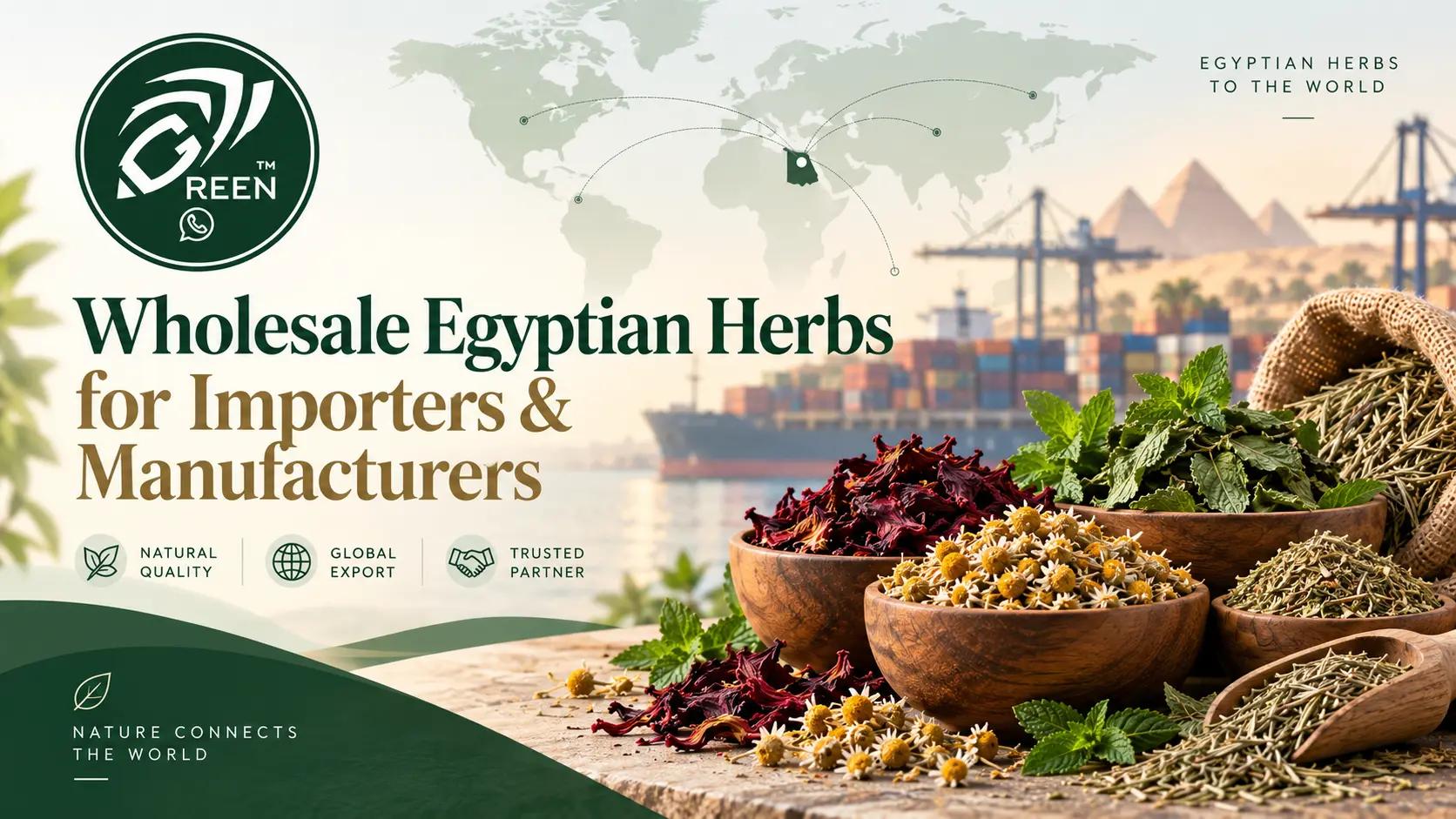
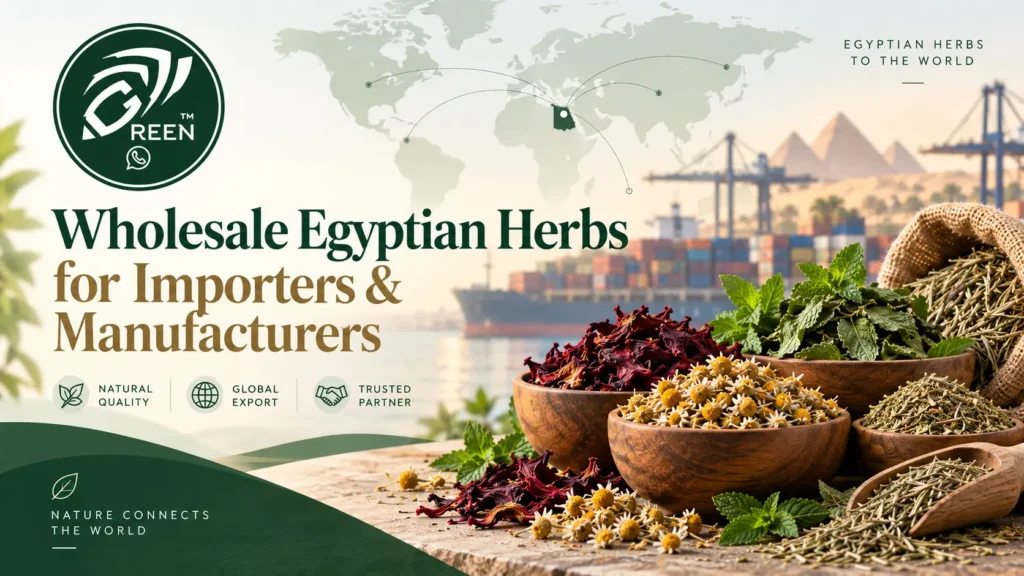
Wholesale Egyptian Herbs for Importers Manufacturers
Sourcing Wholesale Egyptian Herbs for Importers Manufacturers requires more than simply finding agricultural products at competitive prices. International importers, food manufacturers, seasoning companies, distributors, wholesalers, tea businesses, beverage manufacturers, private-label brands, and industrial buyers need herbs that can be supplied in reliable commercial quantities with consistent specifications, professional processing, appropriate packaging, traceability, and organized export support.
Egypt has a long agricultural heritage and produces a wide variety of herbs, botanical flowers, spices, seeds, and natural ingredients used across international food, beverage, herbal, and industrial markets. For commercial buyers, however, origin alone is not enough because the value of dried herbs also depends on cultivation, harvesting, drying, processing, quality control, storage, packaging, and shipment preparation.
Green Company has been cultivating, processing, and supplying Egyptian herbs and spices since 1919. Across four generations, the company has developed an integrated operation built around responsible agriculture, advanced processing, strict quality control, full product traceability, packaging, storage, and international B2B supply.
Why Importers and Manufacturers Source Egyptian Herbs
Egyptian herbs are used across many international food and botanical industries because they can serve a wide range of commercial applications. Manufacturers may use dried herbs in sauces, ready meals, meat products, seasoning systems, soups, bakery products, snacks, marinades, dressings, beverages, and herbal products, while importers may distribute the same ingredients to several businesses in their local markets.
For importers, product availability, packaging, documentation, shipping, and repeat supply are major considerations. For manufacturers, consistency, product form, processing, and suitability for production systems may be more important. A professional supplier should understand both perspectives and prepare the commercial order according to the buyer’s actual requirements.
What Wholesale Buyers Need from an Egyptian Herbs Supplier
Wholesale buyers need more than product names and prices. They need clearly defined specifications, commercial quantities, reliable processing, appropriate packaging, quality management, traceability, export preparation, and communication throughout the purchasing process.
The supplier should also understand the final application because herbs intended for food manufacturing may require different preparation from herbs intended for tea businesses, wholesalers, repacking companies, restaurants, or private-label brands.
A strong B2B relationship begins with clear information about the product, required format, quantity, packaging, destination, and expected purchasing frequency.
Egyptian Herbs for Importers
Importers purchase herbs in commercial quantities and distribute them to manufacturers, wholesalers, retailers, restaurants, tea companies, seasoning businesses, or repacking companies in their own markets. They therefore need a supplier capable of managing product preparation and the wider export process.
A reliable export partner should understand packaging, documentation, logistics, traceability, and repeat orders in addition to agricultural production. Importers may also prefer to source several products from one company in order to simplify procurement and shipment planning.
Egyptian Herbs for Food Manufacturers
Food manufacturers use herbs as ingredients within established recipes and production systems. They may require basil, parsley, marjoram, dill, cilantro, bay leaves, lemongrass, or other ingredients depending on the product they manufacture.
Because manufacturing operations depend on repeatable results, buyers often pay attention to product form, aroma, color, cleanliness, cut, moisture, and consistency between shipments. Large differences from one batch to another may affect the characteristics of the finished product.
For this reason, manufacturers should work with suppliers that understand industrial ingredient requirements rather than treating herbs only as agricultural commodities.
Egyptian Herbs for Seasoning Manufacturers
Seasoning companies may require several herbs within the same production program. These ingredients can be used in blends for meat, poultry, sauces, snacks, marinades, restaurant products, and private-label seasonings.
The required product form can vary depending on the blend, manufacturing process, and finished product. Buyers should therefore define cut, format, quantity, and application before commercial preparation begins.
A diversified supplier can also make purchasing easier when seasoning companies need herbs, spices, seeds, and other ingredients together.
Egyptian Herbs for Distributors
Distributors often supply several customer categories, which makes dependable availability and commercial consistency important. Their customers may include manufacturers, wholesalers, restaurants, retailers, tea companies, and smaller ingredient businesses.
A distributor may purchase several herbs within one order and therefore benefit from working with a supplier offering a wider product portfolio. This can simplify communication and reduce the need to coordinate multiple suppliers.
Egyptian Herbs for Wholesalers
Wholesalers typically purchase commercial quantities for resale to smaller businesses. Their requirements often include practical bulk packaging, reliable availability, stable product condition, efficient storage, and competitive commercial terms.
Because wholesalers may serve multiple customers, product inconsistency can create problems across several downstream relationships. Long-term supplier reliability therefore becomes as important as the first quotation.
Egyptian Herbs for Private-Label Brands
Private-label businesses may require more than raw herbs. Their projects can include blending, preparation, smaller packaging formats, or product combinations developed for a specific retail concept.
A supplier that provides processing, packaging, storage, and international export support can simplify the project by reducing the number of separate companies that need to be coordinated.
Green Company provides commercial solutions designed to support B2B buyers across several stages of sourcing and delivery.
Main Egyptian Herbs for Wholesale Supply
Egypt produces a broad range of herbs suitable for wholesale and industrial use. Depending on the buyer and destination market, commercial sourcing may include basil, marjoram, parsley, dill, cilantro, lemongrass, molokhia, bay leaves, and other dried herbs.
The correct product depends on the final application, and different buyers may require different forms, processing, cuts, quantities, and packaging.
Egyptian Basil
Basil is widely used in pasta sauces, tomato products, pizza seasonings, marinades, ready meals, dry blends, and other Mediterranean food applications. It can be purchased by manufacturers, seasoning companies, wholesalers, distributors, and foodservice businesses.
Commercial buyers may evaluate basil according to aroma, color, cut, cleanliness, processing, and consistency.
The required form should be defined before order confirmation so the supplier can prepare the product according to the final application.
Egyptian Marjoram
Marjoram is commonly used in meat seasonings, savory blends, sauces, ready meals, and Mediterranean food products. Its natural herbal profile makes it useful to manufacturers and seasoning companies that need aromatic dried ingredients.
Importers and manufacturers should define expected product form, quantity, and packaging when requesting a commercial quotation.
Egyptian Parsley
Parsley is widely used in soups, sauces, seasoning blends, vegetable products, dressings, ready meals, and prepared foods. Food manufacturers may require it as part of a recipe, while wholesalers and distributors may purchase it for resale.
Different commercial applications may require different cuts or preparation, so buyers should avoid requesting only a general parsley price without providing specifications.
Egyptian Dill
Dill can be used in pickling, sauces, dressings, seasoning systems, processed foods, and culinary applications. It may be supplied to manufacturers, distributors, wholesalers, restaurants, and repacking businesses.
Buyers should communicate how the dill will be used after arrival so the appropriate commercial format can be discussed.
Egyptian Cilantro
Cilantro is used across many regional and international food applications. It may be incorporated into sauces, marinades, seasoning blends, ready meals, and processed foods.
Commercial sourcing should consider natural aroma, product form, consistency, packaging, and the requirements of the buyer’s production process.
Egyptian Lemongrass
Lemongrass can be used in herbal teas, beverages, infusions, sauces, seasoning systems, and botanical products. Its recognizable citrus profile makes it relevant to food manufacturers, beverage companies, tea businesses, and ingredient distributors.
Bulk buyers may evaluate appearance, aroma, processing, packaging, and consistency across repeat shipments.
Egyptian Bay Leaves
Bay leaves are widely used in soups, stews, sauces, marinades, seasoning products, restaurant kitchens, and industrial food manufacturing. Importers and wholesalers may also purchase them for distribution or repacking.
Commercial buyers should consider leaf condition, natural aroma, product cleanliness, packaging, and consistency when evaluating suppliers.
Egyptian Molokhia
Molokhia is a traditional Egyptian agricultural ingredient that can be supplied to importers, distributors, wholesalers, and food manufacturers serving markets where Middle Eastern and North African foods have established demand.
The required product format and packaging depend on whether the molokhia will be used in manufacturing, repacking, wholesale distribution, or retail products.
Botanical Flowers Alongside Egyptian Herbs
Many importers and manufacturers purchase botanical flowers alongside traditional dried herbs. Products such as hibiscus, chamomile, and calendula can serve tea companies, beverage manufacturers, botanical brands, wholesalers, distributors, and industrial buyers.
Combining these products with other herbs in one sourcing relationship can reduce procurement complexity for buyers managing broader ingredient portfolios.
Egyptian Hibiscus
Hibiscus is used in herbal beverages, teas, infusions, botanical blends, and food applications. Its naturally deep color and characteristic tart profile make it especially relevant to beverage and herbal markets.
Bulk buyers should define the intended use, required product form, quantity, packaging, and destination before requesting a final offer.
Egyptian Chamomile
Chamomile is widely used in herbal teas, botanical blends, and industrial applications. Its gentle floral aroma and natural appearance can be especially important when the flowers remain visible in the final product.
Tea businesses and botanical ingredient buyers may pay particular attention to processing, flower condition, cleanliness, packaging, and batch consistency.
Egyptian Calendula
Calendula can be used in herbal blends, teas, extracts, and selected botanical or food applications. Its natural flower appearance and color are important characteristics for many buyers.
Careful drying, handling, storage, and packaging can help preserve the commercial condition of the product before international delivery.
Agricultural Origin of Wholesale Egyptian Herbs
Herb quality begins at the agricultural stage rather than inside the final packaging facility. Plant selection, cultivation, crop management, harvest timing, and handling can all influence the finished product.
Green Company’s supply-chain approach follows products from seed selection and cultivation through harvesting, processing, quality testing, packaging, and global shipping.
For manufacturers and importers, this gives greater visibility into how the ingredient moves from agricultural origin to delivery.
Seed Selection
Seed selection helps establish the characteristics of the crop from the beginning of the agricultural process. Plant variety can influence yield, aroma, appearance, growth, and suitability for processing.
For recurring B2B purchasing, stronger control from the agricultural stage can support better traceability and more organized future supply.
Responsible Cultivation
Cultivation influences how herbs develop before harvesting. Responsible agricultural management requires attention to crop growth and the careful use of resources throughout the production cycle.
Green Company’s operating model places responsible agriculture among its core principles and connects cultivation with the later processing and export stages.
Harvesting
Harvest timing and handling can affect product condition, natural aroma, color, and suitability for drying. Once the crop is harvested, it must move carefully through processing to preserve its commercial value.
For international buyers, these stages matter because the final shipment reflects decisions made long before packaging begins.
Drying Egyptian Herbs
Drying is one of the most important stages in producing herbs for commercial export. Fresh herbs naturally contain moisture and need to be dried before long-term storage, processing, packaging, and international transportation.
Controlled drying should help preserve natural color, aroma, essential oils, and overall product integrity rather than simply removing moisture.
Green Company provides herb drying and processing as part of its wider B2B ingredient supply services.
Why Controlled Drying Matters
Poorly controlled drying can affect product appearance, aroma, moisture, consistency, and storage performance. These problems can become especially significant when buyers are purchasing large quantities for food manufacturing or distribution.
International buyers should therefore review drying and processing capability when selecting a supplier rather than comparing offers only according to price.
Processing Wholesale Herbs
After drying, herbs may require additional preparation depending on their final use. Some customers need whole herbs, while others may require cut products or ingredients prepared for industrial manufacturing.
The appropriate commercial form should be agreed before order preparation because product size and processing can influence blending, appearance, production performance, packaging, and price.
Whole Herbs
Whole herbs may be suitable for wholesalers, tea businesses, restaurants, repacking companies, and businesses that plan to conduct additional processing after import.
The exact requirement should be communicated clearly so the supplier understands whether the herb needs to remain intact during preparation and shipment.
Cut Herbs
Cut herbs are often preferred by food manufacturers and seasoning businesses because they may be easier to integrate into established production systems.
Different applications may require different cuts, which makes product specifications important before bulk quantities are prepared.
Why Specifications Matter for Manufacturers
A manufacturer purchasing herbs for industrial production cannot rely only on a product name. The supplier should understand the desired form, cut, quantity, packaging, final application, and any additional processing expectations.
Clear specifications help manufacturers maintain more predictable results and allow suppliers to prepare commercial quotations more accurately.
Quality Control for Wholesale Egyptian Herbs
Quality control should be integrated throughout the supply chain rather than limited to inspecting the finished shipment. Herbs can be influenced during cultivation, harvesting, drying, processing, storage, and packaging.
Green Company’s traceability system includes a dedicated quality-testing stage before packaging and global shipping, with batches monitored throughout the broader supply process.
This approach is especially relevant to manufacturers and importers requiring repeat orders.
Batch Consistency
Commercial buyers often purchase the same herb several times during the year. Large differences between batches can affect manufacturing recipes, final product appearance, or customer expectations.
Agricultural products naturally vary, but organized sourcing, processing, quality control, and clearly defined specifications can help reduce unnecessary variation.
Buyers planning recurring purchases should discuss consistency expectations at the beginning of the relationship.
Natural Aroma
Aroma is an important commercial characteristic for many herbs and can be influenced by cultivation, harvest timing, drying, processing, storage, and transportation.
Food manufacturers and seasoning companies using herbs in established recipes may place particular importance on maintaining predictable aromatic characteristics across repeat orders.
Natural Color and Appearance
Color and appearance can be important for leafy herbs and botanical products, particularly when the ingredient remains visible in the finished food or retail package.
Visual condition should always be considered together with aroma, processing, cleanliness, consistency, and the technical requirements of the final application.
Product Cleanliness
Commercial herb buyers expect ingredients to be handled carefully across the complete supply chain. Product cleanliness is influenced by agricultural practices, harvesting, processing, drying, storage, packaging, and transportation.
A reliable supplier should therefore manage quality as a continuous process rather than relying only on a final inspection.
Moisture Management
Dried herbs require appropriate moisture management because products may remain in storage and transportation for extended periods before reaching the final customer.
Exact requirements can differ by herb and application, so manufacturers and importers should communicate any technical specifications before confirming the order.
Full Product Traceability
Traceability gives buyers greater visibility into product origin and preparation. It helps connect a commercial shipment with the stages of cultivation, harvesting, processing, testing, packaging, and international delivery.
Green Company’s traceability system covers seven main stages: seed selection, cultivation, harvesting, processing, quality testing, packaging, and global shipping.
For recurring B2B buyers, this can support more organized batch management and supplier communication.
Why Traceability Matters for Importers
Importers may distribute one shipment across several customers and may need to purchase the same product repeatedly. Better traceability can help them understand the origin and preparation of individual batches.
This transparency becomes particularly useful as purchasing volumes grow and buyers begin supplying larger manufacturers or branded businesses.
Why Traceability Matters for Manufacturers
Manufacturers depend on ingredient suppliers to support stable production. Having greater visibility into where and how an ingredient was prepared can help make procurement more structured and support communication about repeat orders.
Traceability can therefore become an important part of a long-term manufacturing supply relationship.
Packaging Wholesale Egyptian Herbs
Packaging protects dried herbs throughout storage, loading, transportation, customs processes, warehousing, and local distribution. The appropriate format depends on product type, quantity, shipping method, destination, and the buyer’s own operation.
Green Company provides flexible packaging solutions for wholesale, retail, and export markets, allowing different B2B customers to discuss packaging according to their commercial requirements.
Bulk Packaging for Importers
Importers often need packaging designed for international transportation followed by local storage and distribution. The selected format should help protect the product while remaining practical for loading, warehousing, and redistribution.
Packaging requirements should be agreed early because they can also affect transportation volume and overall shipment planning.
Packaging for Manufacturers
Manufacturers may prefer packaging that works efficiently within production facilities. Ingredient consumption, warehouse systems, internal handling, and production schedules can all influence the appropriate format.
Importers supplying factories should understand these requirements before finalizing packaging with the exporter.
Packaging for Wholesalers
Wholesalers need packaging that can be stored efficiently and divided across different customers. Pack size, warehouse space, product protection, and distribution practices may influence the preferred format.
Flexible packaging capability can therefore be valuable when one supplier serves several types of wholesale buyers.
Packaging for Private-Label Brands
Private-label businesses may need different packaging sizes or product combinations according to their target market and retail strategy.
Working with a supplier that supports both ingredients and packaging can simplify commercial projects and reduce the need to coordinate separate providers.
Storage Before Export
Wholesale herbs may need to remain in storage while the order is completed, packaging is prepared, documentation is finalized, additional products are consolidated, or transportation is scheduled.
Appropriate handling throughout this stage helps maintain product condition before dispatch.
Green Company’s broader supply model includes sourcing, processing, packaging, storage, and global delivery.
Export Documentation for Wholesale Herbs
International herb shipments require appropriate documentation, but exact requirements can vary according to product, destination country, importer, transportation method, and applicable regulations.
Buyers should communicate documentation expectations early rather than waiting until the shipment has already been prepared.
Green Company’s export services cover preparation and documentation alongside packaging and logistics support.
Why the Destination Country Matters
Different destination markets may have different import procedures and requirements. A shipment being prepared for one country may therefore require different documentation or logistics arrangements from another.
The buyer should provide the destination country when requesting a commercial quotation so relevant requirements can be considered from the beginning.
Shipping Wholesale Egyptian Herbs
After products have been processed, checked, packaged, and documented, the shipment can move into international transportation. Logistics depend on order volume, packaging, destination, shipping method, delivery schedule, and commercial terms.
For larger wholesale orders, transportation planning should begin early because it can influence packaging, consolidation, shipment timing, and total cost.
Consolidating Several Herbs in One Order
Importers and manufacturers often require several ingredients instead of one product. A commercial order may include multiple herbs, botanical flowers, spices, seeds, or blends.
Working with one diversified supplier can simplify communication, documentation, packaging coordination, and shipment planning.
This can be especially useful for distributors and manufacturers managing large ingredient portfolios.
Long-Term Wholesale Supply
Many B2B buyers require recurring shipments rather than one-time purchases. Demand may depend on manufacturing schedules, annual contracts, distributor inventory, seasonal sales, or customer requirements.
A long-term supplier relationship helps both parties develop a clearer understanding of specifications, quantities, packaging, documentation, and expected shipment schedules.
Over time, repeat ordering can become easier and more efficient.
How to Choose a Wholesale Egyptian Herbs Supplier
Choosing a supplier should involve evaluating much more than price. Buyers should consider agricultural experience, product range, drying, processing, quality control, traceability, packaging, storage, documentation, export capability, communication, and repeat-supply capacity.
A supplier that manages these stages through an integrated system can give importers and manufacturers better visibility throughout the purchasing process.
Check Agricultural Experience
Experience in agricultural ingredients can help a supplier understand how cultivation, harvesting, drying, processing, and storage affect the final product.
Green Company’s history dates back to 1919 and extends across four generations working with Egyptian herbs and spices.
This agricultural heritage forms the foundation of its current B2B supply model.
Review the Product Range
A broad portfolio can help manufacturers, importers, and distributors consolidate several sourcing requirements.
Green Company supplies herbs, spices, flowers, seeds, and natural ingredients for manufacturers, distributors, brands, wholesalers, and industrial buyers.
This gives buyers more flexibility when building larger purchasing programs.
Evaluate Drying and Processing
Buyers should understand how herbs are handled after harvesting and what processing is performed before shipment.
Drying, cutting, handling, storage, and other preparation stages can influence product quality and suitability for manufacturing.
Green Company’s processing approach is designed to preserve natural characteristics and prepare ingredients for commercial use.
Review Quality Control
Quality should be managed throughout the supply chain instead of being inspected only after packaging.
Green Company includes quality testing as a specific stage within its traceability system and monitors batches through the product journey.
For manufacturers and importers, this creates a more organized approach to repeat purchasing.
Ask About Traceability
Traceability can help international buyers understand how ingredients move from agricultural origin through processing and export.
This becomes particularly relevant when managing several shipments, customer specifications, and repeat manufacturing requirements.
Review Packaging Options
Packaging should match the herb, commercial quantity, transportation method, storage environment, destination, and buyer’s distribution model.
A supplier offering multiple formats can better support manufacturers, importers, wholesalers, and private-label customers.
Evaluate Export Capability
A wholesale exporter should understand product preparation, documentation, packaging, storage, logistics, and global shipment coordination.
Importers can benefit from working with suppliers capable of managing these stages within one commercial relationship.
Consider Repeat-Supply Capability
The first shipment should not be the only factor considered when selecting a supplier. Future purchasing may involve larger quantities, additional herbs, different specifications, more frequent shipments, or new packaging requirements.
Manufacturers and importers should evaluate whether the supplier can support their long-term growth.
How to Request a Wholesale Herbs Quotation
A professional inquiry should clearly state the herbs required, commercial quantities, product forms, processing requirements, packaging preferences, destination country, intended applications, delivery schedule, purchasing frequency, and any special documentation needs.
Providing complete information helps the exporter prepare a commercial offer based on the actual project rather than only providing a general price.
What Affects Wholesale Egyptian Herbs Prices?
There is no single fixed price for all Egyptian herbs. Commercial quotations can depend on product type, crop availability, season, processing, specification, order quantity, packaging, destination, transportation, and additional services.
Buyers should therefore compare suppliers according to the complete scope of supply rather than looking only at price per kilogram.
Product Type and Price
Different herbs require different cultivation, harvesting, drying, and processing methods. Basil, chamomile, hibiscus, parsley, marjoram, and bay leaves therefore cannot all follow the same commercial pricing structure.
Buyers should request prices for the exact product and specification required.
Crop Availability and Season
Herbs are agricultural products, so availability can be influenced by growing cycles, harvest timing, production volumes, and market demand.
Companies planning recurring orders may benefit from discussing expected annual quantities in advance so supply can be planned more effectively.
Processing and Price
Different processing requirements may influence the final quotation. A customer requesting a specific cut or preparation may receive a different price from a wholesaler purchasing a standard bulk format.
Processing specifications should therefore be agreed before final pricing.
Quantity and Price
Order volume influences processing, packaging, storage, loading, and logistics planning.
Providing expected quantities helps the supplier understand the commercial scale of the order and prepare a more relevant quotation.
Packaging and Price
Packaging materials, weights, formats, and handling requirements can affect total cost. Industrial bulk packaging differs from smaller wholesale or retail formats.
Packaging preferences should therefore be included in the quotation request.
Destination and Shipping Cost
The destination country affects shipping, documentation, logistics, and transportation costs.
Providing the final destination allows the exporter to prepare a more complete commercial discussion and helps the buyer evaluate total purchasing cost more accurately.
Common Mistakes When Buying Egyptian Herbs Wholesale
One common mistake is choosing a supplier only because of the lowest initial price. Buyers should also evaluate product consistency, processing, quality control, traceability, packaging, export capability, communication, and long-term supply reliability.
Another mistake is requesting a general herb price without specifying product, quantity, form, packaging, destination, or intended application. Incomplete information makes accurate commercial pricing difficult.
Not Defining Product Specifications
A buyer should not assume that every supplier interprets a herb product in exactly the same way. Product form, cut, preparation, quantity, and packaging should be defined clearly.
Detailed specifications help prevent misunderstandings and make supplier comparisons more meaningful.
Not Explaining the Final Application
The same herb can serve several industries. A seasoning manufacturer may need a different form from a tea business, wholesaler, or restaurant supplier.
Explaining the final application allows the exporter to understand the buyer’s actual commercial needs.
Leaving Packaging Until the End
Packaging influences protection, storage, loading, transportation, and final cost.
It should therefore be discussed alongside the product specification rather than added after production is complete.
Ignoring Destination Requirements
Different international markets may have different import and documentation requirements.
Buyers should review local requirements and communicate relevant details before the shipment reaches the final preparation stage.
Focusing Only on the First Order
Importers and manufacturers should evaluate whether a supplier can support long-term demand rather than focusing only on one shipment.
Future requirements may include larger quantities, more products, different packaging, or more frequent orders.
A stable supplier relationship can provide greater commercial value over time.
Sustainability in Egyptian Herb Supply
Responsible agricultural sourcing is becoming increasingly relevant to international buyers. Sustainability can involve natural-resource protection, responsible water and energy management, support for local communities, and greater supply-chain transparency.
Green Company’s approach focuses on responsible farming, protecting natural resources, supporting local communities, and building a transparent long-term supply chain. The company reports 21 newly planted species, a 10% reduction in electricity consumption, and a 15% reduction in water usage.
Why Long-Term Supplier Relationships Matter
Long-term supplier relationships help manufacturers and importers develop clearer expectations around specifications, quantities, packaging, quality, documentation, and delivery schedules.
Over time, repeat orders can become easier to manage because both parties already understand the commercial requirements.
This can help buyers plan purchasing and inventory more efficiently.
Why Choose Green Company for Wholesale Egyptian Herbs for Importers Manufacturers?
Green Company combines more than a century of agricultural heritage with professional processing, strict quality control, full product traceability, flexible packaging, storage, and international export support. Since 1919 and across four generations, the company has worked to connect Egyptian herbs and natural ingredients with global B2B markets.
For importers and manufacturers, this integrated approach means the relationship can cover the complete journey from agricultural origin through processing and international delivery rather than only the sale of a finished herb.
More Than 100 Years of Experience
Green Company’s history dates back to 1919 and spans four generations. During this period, the company has continued to develop its agricultural, processing, quality-control, traceability, packaging, and international supply capabilities.
This experience supports its focus on quality, transparency, reliability, and long-term partnerships.
Broad Egyptian Herbs Portfolio
Green Company supplies Egyptian herbs, botanical flowers, spices, seeds, and other natural ingredients for different commercial applications.
This broader portfolio gives importers, manufacturers, distributors, and wholesalers the ability to source several ingredient categories through one commercial relationship.
Farm-to-Shipment Traceability
Green Company’s traceability process follows seven main stages: seed selection, cultivation, harvesting, processing, quality testing, packaging, and global shipping.
This gives commercial buyers greater visibility into the product journey and supports a more transparent supply relationship.
Strict Quality Control
Green Company integrates quality control into its supply process and monitors batches through different stages before packaging and shipment.
For manufacturers, this structured approach is particularly important because ingredients may need to fit established recipes and production systems.
Professional Drying and Processing
Green Company provides drying and processing services designed to preserve natural color, aroma, essential oils, and overall ingredient quality.
This can help manufacturers and importers source herbs that are better prepared for commercial distribution and industrial use.
Flexible Packaging Solutions
Green Company provides different packaging formats for wholesale, retail, and export requirements.
This allows importers, manufacturers, distributors, and private-label brands to discuss packaging according to their own storage, production, and distribution models.
Custom Herb and Spice Blends
Green Company also provides customized herb and spice blends for manufacturers, restaurants, retailers, private-label brands, and other commercial customers.
These solutions allow buyers to discuss flavor, aroma, application, and commercial quantities when they require a finished blend rather than individual ingredients.
Professional Export Solutions
Green Company’s export services cover preparation, documentation, packaging, logistics, and international delivery support.
For importers, coordinating these stages through one supplier can simplify purchasing and shipment preparation.
Built for B2B Buyers
Green Company’s supply model is designed around manufacturers, importers, distributors, wholesalers, brands, and industrial buyers requiring commercial ingredient supply.
This B2B focus places quantities, specifications, processing, packaging, traceability, repeat supply, and international delivery at the center of the relationship.
Responsible Long-Term Supply
Green Company’s sustainability approach focuses on responsible agriculture, natural-resource management, local communities, and supply-chain transparency.
This supports the company’s wider goal of building long-term partnerships based on quality, trust, and reliable supply.
From Egypt’s Fields to Global Markets
Green Company’s operating model connects Egyptian agricultural production with international buyers through cultivation, processing, quality testing, traceability, packaging, storage, and global delivery.
For businesses looking for Wholesale Egyptian Herbs for Importers Manufacturers, evaluating this complete supply system is essential when choosing a dependable long-term B2B partner.
Tips Before Ordering Wholesale Egyptian Herbs
Before confirming an order, buyers should clearly identify the required herbs, quantities, product forms, processing specifications, intended applications, packaging preferences, destination country, delivery schedule, documentation requirements, and expected purchasing frequency. They should also evaluate the supplier’s agricultural experience, processing capabilities, quality-control system, traceability, packaging, storage, export experience, and ability to support repeat orders.
Requesting representative samples when appropriate and discussing expected annual purchasing volumes can help both buyer and supplier establish clearer expectations before beginning a long-term relationship.
Frequently Asked Questions About Wholesale Egyptian Herbs
Can Egyptian Herbs Be Supplied in Wholesale Quantities?
Yes. Egyptian herbs can be supplied in commercial quantities to importers, food manufacturers, seasoning companies, wholesalers, distributors, tea businesses, brands, and industrial buyers depending on product specifications and destination requirements.
What Egyptian Herbs Can Green Company Supply?
Green Company’s wider portfolio includes Egyptian herbs, botanical flowers, spices, seeds, and natural ingredients for B2B customers. Its product focus includes herbs and featured products such as hibiscus, chamomile, calendula, bay leaves, black pepper, and black lime.
Does Green Company Work with Importers?
Yes. Green Company’s export model is designed to support international B2B buyers requiring commercial quantities, packaging, documentation, logistics, and repeat supply.
Does Green Company Work with Food Manufacturers?
Yes. Green Company’s product and service model is designed for food manufacturers, distributors, brands, wholesalers, industrial buyers, and other commercial customers.
Does Green Company Provide Herb Processing?
Yes. Green Company provides drying and processing services designed to preserve natural color, aroma, essential oils, and overall product quality.
Does Green Company Provide Wholesale Packaging?
Yes. Green Company provides flexible packaging solutions in different weights and formats for wholesale, retail, and export requirements.
Are Green Company’s Products Traceable?
Yes. Green Company’s traceability process covers seed selection, cultivation, harvesting, processing, quality testing, packaging, and global shipping.
Does Green Company Provide International Export Support?
Yes. Green Company’s export solutions cover product preparation, documentation, packaging, logistics, and global delivery support.
What Information Should Buyers Send When Requesting a Wholesale Quote?
Buyers should provide the exact herbs required, estimated quantities, product forms, processing requirements, packaging preferences, destination country, intended applications, delivery schedule, purchasing frequency, and any special documentation requirements. Complete information allows the supplier to prepare a more accurate commercial quotation.
Conclusion
Sourcing Wholesale Egyptian Herbs for Importers Manufacturers requires evaluating far more than product price. International buyers should consider agricultural origin, cultivation, harvesting, drying, processing, quality control, consistency, traceability, packaging, storage, documentation, logistics, and long-term supply capability.
Importers and manufacturers should clearly define product specifications, commercial quantities, packaging, destination, and final application so the supplier can prepare ingredients according to the actual business requirement.
With a heritage dating back to 1919 and extending across four generations, Green Company supplies Egyptian herbs and natural ingredients through an integrated system combining responsible agriculture, professional processing, strict quality management, full traceability, flexible packaging, and international export solutions.
From Egypt’s fields to global markets, Green Company supports importers, food manufacturers, distributors, wholesalers, brands, and industrial buyers looking for reliable Egyptian herbs and long-term B2B supply partnerships.